

SCETA Submits Comments on Spartanburg County Data Center Moratorium
By Dennis Fassuliotis President, South Carolina Emerging Tech Association

September 10, 2026
On September 9, 2026, the Spartanburg County Council Public Safety Committee held a special hearing on data centers. The meeting included presentations from the Southern Environmental Law Center and NorthMark Strategies, public testimony, committee questions, and discussion of the proposed data center moratorium.
The testimony demonstrated that “data center” is too broad a label to serve as a complete public policy. Smaller grid supplied facilities, digital asset mining operations, hyperscale campuses, and facilities with extensive onsite generation do not present identical infrastructure, environmental, or community impacts.
SCETA submitted the following written comments for inclusion in the hearing record. The comments recognize residents’ concerns while calling for measurable standards, appropriate cost allocation, protection of existing ratepayers, and coordination between state and local government.
Written Comments for the Record
September 10, 2026
Angela Walker
Clerk to Council
Spartanburg County
366 North Church Street, Suite 1000
Spartanburg, South Carolina 29303-3637
Re: Written Comments for the Record Regarding the September 9, 2026 Data Center Moratorium Hearing
Dear Ms. Walker:
Thank you for confirming that I could submit written comments for the record after watching the September 9 Public Safety Committee hearing by livestream. I watched the hearing, including the presentations, public testimony, and committee questioning, and respectfully request that these comments be included in the record.
The hearing demonstrated why Spartanburg County needs a measured, tiered approach rather than treating every computing facility as though it presents the same risks.
Bryan Stone’s testimony on behalf of Lockhart Power and Pacolet Milliken was particularly important. He stated that Lockhart Power currently serves four facilities falling within the County’s proposed definition of a data center, including digital asset mining operations; that each is below 50 megawatts; and that these grid supplied customers have helped support lower rates for Lockhart customers. He also testified that Lockhart Power has not had a rate case in 12 years and recently lost a major manufacturing load.
That testimony deserves careful consideration. A definition beginning at one megawatt could unintentionally capture corporate computing facilities, smaller data centers, digital asset miners, and other industrial users that bear little resemblance to a 450 megawatt campus with extensive onsite generation. A blanket moratorium could discourage responsible projects without resolving the distinct issues presented by Valara.
South Carolina law already recognizes one of these distinctions. S.163, enacted as Act 208 on May 19, 2026, defines a digital asset mining business as an operation drawing more than one megawatt. It provides that such a business operating in an industrially zoned area may not be subjected to restrictions that do not generally apply to other businesses in that area.
It also requires the mining business to operate without placing additional stress on the electrical grid and, upon request, provide its power purchase agreement to the Public Service Commission demonstrating its ability to reduce consumption during periods of grid stress. See S.C. Code Sections 34-47-40 and 34-47-50.
S.163 does not establish a general category for all large or interruptible loads. It does, however, establish a valuable performance based precedent: evaluate computational loads by their actual effects on the grid and their ability to curtail consumption, rather than simply by the technology operating inside the building.
Because the County’s proposed definition appears to include digital asset mining, its relationship to S.163 warrants careful legal review. The County should avoid adopting a definition or restriction that unintentionally conflicts with state law or treats smaller, flexible mining loads the same as hyperscale facilities with onsite generation.
This discussion is also occurring while members of the South Carolina House are working on related proposals for possible 2027 prefiling. Those working drafts build upon the S.163 foundation by addressing large energy users and compute infrastructure more broadly, including cost causation, load flexibility, demand response, infrastructure planning, ratepayer protection, water and cooling, noise, siting, and long term obligations. A related Energy Campus proposal would coordinate generation, transmission, compute infrastructure, economic development, and national security priorities without creating another regulatory agency.
These remain working drafts, not final legislation. Nevertheless, Spartanburg County should be aware that a statewide framework is being developed and should contribute its experience to that process. State standards and local authority should complement each other. The State should establish consistent requirements for grid reliability, utility regulation, environmental oversight, and ratepayer protection, while counties retain meaningful authority over land use, setbacks, noise, compatibility, emergency response, and local development agreements.
SCETA is already participating in the statewide regulatory process. On July 24, 2026, SCETA filed written comments in Public Service Commission Docket No. 2026-138-E, Matter No. 340045, the generic docket addressing large load additions. Those comments recommend full cost causation, ratepayer protection, load flexibility, demand response, performance metrics, brownfield and underutilized industrial sites, and preservation of local zoning, permitting, and development agreement authority. On September 3, 2026, the Commission granted SCETA’s request to comment. The complete PSC docket provides the filed record and procedural history.
At the same time, the residents’ testimony raised legitimate concerns about noise, air emissions, water, setbacks, emergency response, property impacts, affordability, transparency, and enforcement. Those concerns should become measurable standards rather than remain competing assertions.
The hearing also illustrated the need to distinguish evidence from assumptions. Testimony attributing current residential utility increases to Valara appeared inconsistent with the discussion indicating that the facility is not yet consuming natural gas for its proposed onsite generation. Similarly, conclusions drawn from sulfur dioxide emissions at a paper mill cannot automatically be applied to this facility without a project specific emissions inventory and dispersion analysis. Conversely, claims that large load customers reduce residential rates should be supported by cost of service information and appropriate rate protections.
I recommend that the County use this process to establish:
1. Separate classifications for enterprise computing, digital asset mining, grid supplied data centers, hyperscale campuses, and facilities using onsite generation.
2. Graduated requirements based on electrical load, acreage, proximity to residences, water consumption, emissions, and onsite generation, and not simply whether a building contains computers.
3. A reasonable exemption for smaller, grid supplied facilities, potentially within the 50 to 75 megawatt range discussed during the hearing, subject to appropriate siting and operating standards and consistency with S.163.
4. Property line noise limits, setbacks, water use disclosures, emissions compliance, emergency response plans, continuous monitoring where appropriate, and meaningful enforcement remedies.
5. Requirements that large load customers bear the infrastructure costs they create, protect existing ratepayers, and participate in interruptible service or demand response programs where feasible.
6. Earlier public notice and an understandable review process for projects crossing defined load, acreage, generation, or investment thresholds, while recognizing that legitimate economic development negotiations may initially require confidentiality.
The central lesson from the hearing is that “data center” is too broad a label to serve as a complete policy. Spartanburg County can protect residents without closing the door on responsible investment, and it can welcome investment without giving up the safeguards residents reasonably expect.
The goal should not be development at any cost or opposition to every project. It should be a framework that distinguishes among technologies, assigns costs appropriately, establishes enforceable protections, and permits projects capable of demonstrating a net benefit to the community.
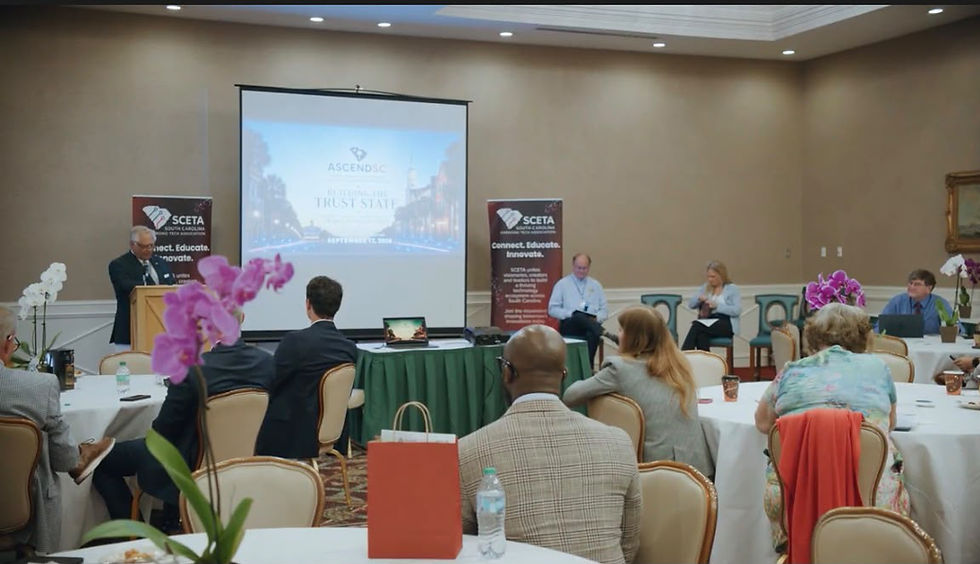
These same issues will be examined at ASCENDSC™ 2026: Building the Trust State™, September 16 through 18, 2026, at the Town & Country Inn and Suites in Charleston. The forum will bring policymakers, county and municipal leaders, utilities, developers, and technology experts together to discuss energy, compute, capital, policy, identity, and payments. I respectfully invite every member of Spartanburg County Council, the Spartanburg County Legislative Delegation, and appropriate staff to participate and share Spartanburg County’s experience. Forum information and registration are available at SCETA.io.
Thank you for accepting these comments and providing them to the members of the Public Safety Committee and County Council.
Respectfully submitted,
Dennis Fassuliotis
President
South Carolina Emerging Tech Association, Inc.
cc: Spartanburg County Legislative Delegation; Senator Tom Davis; Representative William G. “Bill” Herbkersman


Comments